What if the persistent tension in your shoulders or that stubborn calf tightness isn’t actually a lack of stretching, but a sign that your body’s recovery budget is simply overdrawn? If you’ve ever found yourself wondering how often should you get a sports massage to see genuine results, you’re certainly not alone. Many of our clients arrive feeling confused about whether clinical soft tissue work is a luxury indulgence or a fundamental necessity for their physical health. It’s common to feel a sense of frustration when your usual recovery routine fails to prevent that nagging fear of injury during a heavy training cycle or a stressful week at the office.
We believe that your treatment frequency should be as unique as your anatomy and your lifestyle. In this 2026 guide, we’ll help you establish a clear, personalised schedule that balances your physical load with your body’s natural healing pace. You’ll discover how to transition from reactive pain management to proactive care, whether you’re an elite athlete or someone navigating the postural strains of a modern desk job. We’ll outline exactly how to improve your flexibility and significantly reduce your risk of injury, allowing you to move with renewed confidence and ease.
Key Takeaways
- Understand how your training volume, injury history, and daily stress levels dictate your personal “maintenance budget” for physical recovery.
- Discover exactly how often should you get a sports massage based on your specific lifestyle, whether you’re training for a marathon or managing office-based postural tension.
- Learn how regular soft tissue therapy supports the muscle remodelling phase, helping to maintain elasticity and prevent long-term tightness.
- Identify the subtle physical cues, such as persistent stiffness, that signal your body needs a session before a minor niggle becomes a clinical injury.
- Explore why a tailored, assessment-led approach from FHT and HCPC accredited therapists provides superior results compared to standard spa-style routines.
Understanding Why Sports Massage Frequency Isn’t One-Size-Fits-All
Sports massage is a targeted form of clinical soft tissue manipulation designed to maintain physiological health. Unlike a standard Swedish massage, which focuses on general relaxation and sensory comfort, the sports modality is goal-oriented. It addresses specific mechanical issues. Determining how often should you get a sports massage depends on a sophisticated balance of your physical demands and your body’s ability to repair itself.
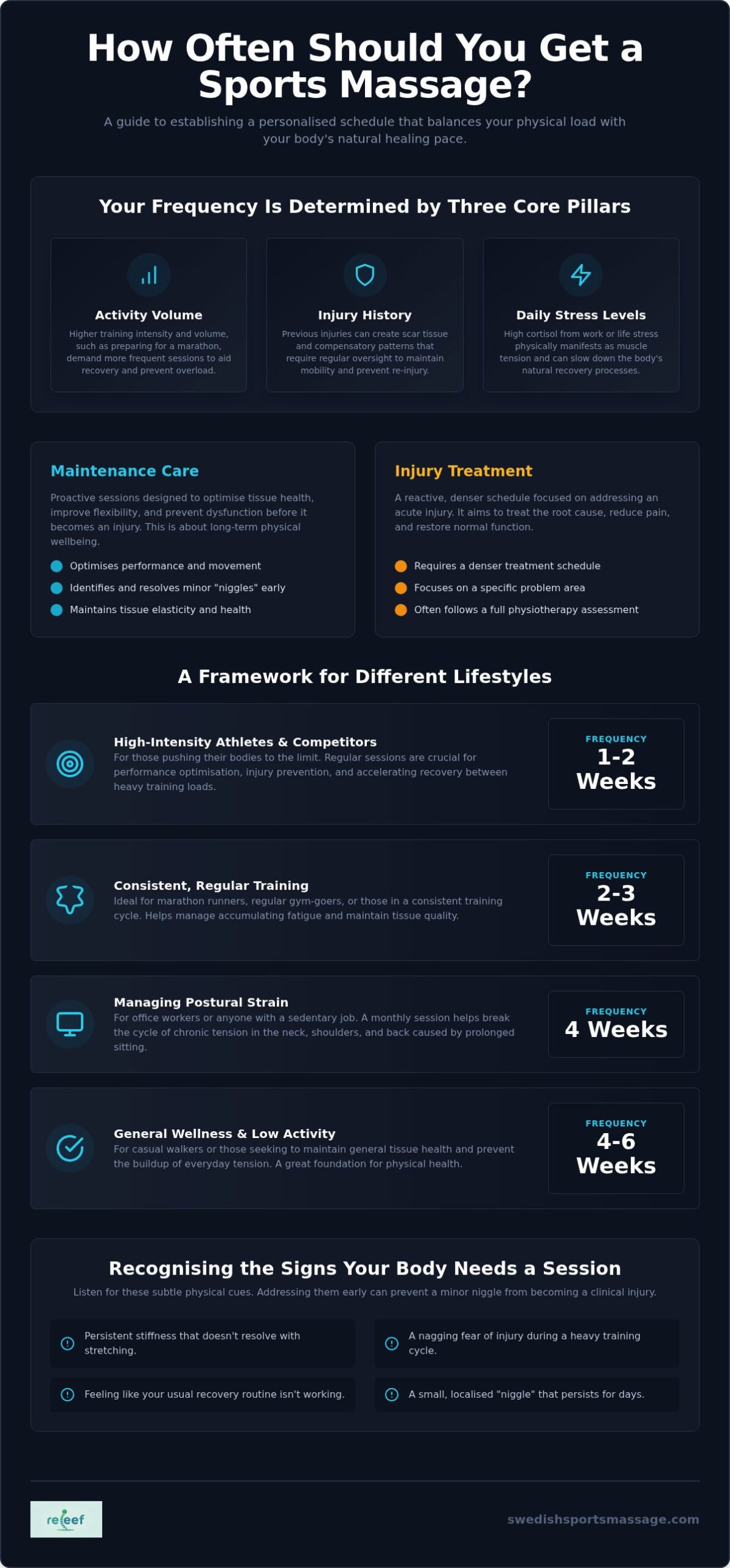
We look at three specific pillars to determine your schedule:
- Activity Volume: A runner training for the Leeds Marathon has vastly different needs than a casual weekend walker.
- Injury History: Previous trauma creates scar tissue or compensatory patterns that require more regular oversight.
- Stress Levels: High cortisol levels from a demanding job can physically manifest as muscle tension and slow down your recovery.
Adopting a maintenance mindset is about preventing the breakdown before it happens. Many people wait until they’re in acute pain to book an appointment. This reactive approach often leads to longer recovery times and more frustration. Regular sessions allow us to use Manual therapy techniques to identify small dysfunctions before they escalate into something more serious. When considering how often should you get a sports massage, remember that consistency often yields better long-term results than occasional, intense sessions.
The Difference Between Maintenance and Injury Treatment
Maintenance sessions are about optimising tissue health and keeping you moving fluidly. If you’re currently managing an acute injury, your schedule will naturally be denser. In these cases, a full Physiotherapy assessment is often the necessary first step to ensure we’re treating the root cause. Regular maintenance helps us find those subtle “niggles” in your soft tissue. Catching these early means you won’t have to stop training or miss work due to a debilitating injury.
Why Your Body’s Recovery Rate Dictates Your Schedule
Your body doesn’t just feel better after a massage; it undergoes a physiological shift. The pressure improves blood flow and assists lymphatic drainage, which are essential for clearing metabolic waste and delivering nutrients to muscle fibres. If you’re under chronic stress, your cortisol levels rise. This hormonal shift can actually impede your body’s natural repair mechanisms. Consequently, you might need more frequent intervention to offset this delay. Tissue turnover refers to the biological process where old or damaged proteins within your muscles and tendons are replaced by new, healthy ones, a cycle that typically dictates the ideal window between your treatment sessions.
The Science of Soft Tissue: How Massage Affects Your Body Over Time
The benefits of sports massage aren’t just immediate; they’re cumulative. When you consider how often should you get a sports massage, it’s helpful to view each session as a layer of progress in your physical health. Over time, consistent work improves muscle elasticity and supports the remodelling phase of tissue repair. This is the stage where your body reorganises collagen fibres to ensure your muscles are both strong and flexible. There is significant scientific evidence for massage therapy suggesting that it reduces markers of inflammation and enhances the rate of recovery after strenuous exercise.
Breaking the Cycle of Chronic Muscle Tension
Repetitive strain and poor postural habits often lead to the formation of trigger points, commonly known as “knots.” These are essentially small areas of hyper-irritable tissue that remain in a state of contraction. If you’ve spent years sitting at a desk or following a specific training pattern, a single session won’t magically undo those ingrained habits. It takes repeated intervention to influence the fascia, the intricate web of connective tissue that wraps around your muscles. Regular sessions keep this fascia supple, preventing it from becoming thick and restrictive.
The Physiological ‘Reset’ for the Nervous System
Beyond the physical muscles, sports massage acts as a vital reset for your autonomic nervous system. For those working in the fast-paced environment of Leeds city centre, the body often remains stuck in a sympathetic “fight or flight” state. This chronic activation leads to mental fatigue and physical rigidity. By modulating the nervous system, regular therapy helps shift you into a parasympathetic “rest and digest” state. This transition is crucial for improving sleep quality. Better sleep leads to better hormonal balance and, ultimately, more efficient physical recovery.
To get the most out of your treatment, your behaviour between appointments matters just as much as the time on the table. Staying hydrated helps flush metabolic by-products, whilst gentle movement ensures your tissues remain mobile. If you’re ready to move beyond temporary relief and start a structured recovery journey, our team at Swedish Sports Massage Leeds can help you design a plan that fits your specific goals. Understanding how often should you get a sports massage is the first step toward a more resilient, pain-free body.
Choosing Your Frequency: A Framework for Different Lifestyles
Determining how often should you get a sports massage requires an honest assessment of your weekly physical load. There is no universal “correct” number because your body’s needs are entirely individual. A professional athlete with the Leeds Rhinos operates on a different physiological timeline than a casual weekend hiker. We often describe this as a “Maintenance Budget.” By investing in regular soft tissue work now, you’re effectively saving yourself from the significant “cost” of future injury downtime. It’s important to prioritise consistency over intensity; one deep, painful session every six months is far less effective than lighter, strategic maintenance performed at regular intervals.
Your schedule should also be flexible enough to reflect the changing seasons of your life. You might require more frequent intervention during a heavy winter training block, whilst dropping back to a longer interval during a restful summer period. This adaptive approach ensures your body receives support exactly when the demand is highest.
The High-Performance Athlete (Weekly to Fortnightly)
If you’re training five or more times a week or preparing for demanding local events like the Leeds 10K, your tissues are under constant mechanical demand. For this group, we typically recommend sessions every seven to fourteen days. At this frequency, the focus is on flushing metabolic waste and maintaining an optimal joint range of motion. Pre-event sessions help prime the muscles for peak performance, whilst post-event work is essential for accelerating the repair of micro-trauma in the muscle fibres.
The Active Enthusiast and Gym-Goer (Every 3 to 4 Weeks)
This category is ideal for those balancing a busy career with regular exercise, weightlifting, or club-level sports. A frequency of every three to four weeks allows us to address specific “tight spots” before they evolve into overuse injuries. Our clinical approach to sports massage for gym goers in Leeds focuses on the unique demands of resistance training. We ensure your mobility keeps pace with your strength gains, preventing the stiffness that often follows heavy lifting cycles.
The Office Professional and Postural Maintenance (Every 4 to 6 Weeks)
You don’t need to be a competitive runner to benefit from professional soft tissue work. Desk-based roles in the city centre often lead to “tech neck,” rounded shoulders, and significant lower back stiffness due to prolonged sitting. For postural maintenance, a session every four to six weeks is usually sufficient to manage these issues. We focus on opening up the chest and shoulders whilst releasing tension in the hips and glutes. During your initial consultation, a postural analysis helps us determine if this frequency is enough to counteract the specific strains of your workplace environment. Understanding how often should you get a sports massage in a professional context can be the key to avoiding chronic work-related pain.
Recognising the Signs: When Your Body Needs an Extra Session
Whilst our previous frameworks provide a solid baseline, your body often communicates its needs through subtle whispers before it starts shouting in pain. Learning to interpret these cues is vital for maintaining your physical longevity. If you find yourself repeatedly questioning how often should you get a sports massage, the answer might lie in your current physical sensations rather than just the date on the calendar. We encourage our clients to adopt the “2-day rule”: if a specific niggle or area of tightness persists for more than 48 hours despite your usual stretching or rest, it’s typically time to book a session. Ignoring these signals often leads to compensatory movements that create secondary issues elsewhere in the body.
Stiffness is rarely just an inevitable part of training or a busy life. It’s often the first warning sign of a pending injury. When your muscles lose their usual pliability, they can’t absorb shock as effectively, which places unnecessary strain on your joints and tendons. By responding to these early indicators, you can prevent a minor inconvenience from becoming a long-term clinical issue.
Physical Red Flags to Monitor
Reduced range of motion is one of the most reliable indicators that your soft tissue needs attention. This might manifest as struggling to check your blind spot whilst driving or finding it difficult to reach for items on a high shelf. Additionally, waking up feeling “stiff” or “heavy” in your limbs suggests that your lymphatic system isn’t efficiently clearing metabolic waste overnight. For athletes, a sudden drop in performance or muscles that feel “snappy” rather than fluid during training often signals that the tissue is reaching its physiological limit. These symptoms suggest that your current recovery interval may need to be shortened.
The Impact of Increased Stress and Load
Mental fatigue and physical tension are deeply intertwined. A particularly demanding week at work can cause you to subconsciously clench your jaw or hike your shoulders, leading to intense tension in the trapezius muscles. This “fight or flight” response physically manifests as rigidity that stretches alone cannot fix. Similarly, if you’ve recently started a new marathon programme or significantly increased your training mileage, your recovery needs will spike. In these instances, an emergency “reset” session is a practical way to manage the increased load on your nervous system and muscles. Understanding how often should you get a sports massage means being flexible enough to add a session when your lifestyle demands it.
If you’ve noticed any of these red flags in the last 48 hours, don’t wait for your next scheduled appointment. You can book a clinical assessment with our specialist team in Leeds to address the issue before it escalates and keep your recovery on track.
Creating a Personalised Recovery Plan at Swedish Sports Massage Leeds
Determining how often should you get a sports massage is a vital first step, but the true value lies in the quality and precision of the intervention itself. At Swedish Sports Massage Leeds, we provide a professional alternative to standard spa-style treatments. Led by Hitanshu Arora and Paris Hussain, our clinic operates with a clinical focus that prioritises long-term rehabilitation over temporary relief. We don’t simply “rub” muscles; we assess the underlying mechanical issues and design a path toward physical ease. As FHT and HCPC accredited therapists, we bring a level of medical authority that builds immediate trust, ensuring your recovery is managed by experts who are deeply invested in your well-being.
Our Leeds clinic is designed to be a supportive partner in your health journey. We understand that your needs may shift as your training cycles or work demands change. By maintaining a consistent presence in your recovery routine, we can adjust your treatment plan in real-time. This proactive approach ensures that your “maintenance budget” is always working effectively to keep you moving without restriction or pain.
Combining Massage with Clinical Physiotherapy
We believe that soft tissue work is most effective when it facilitates better movement. By using sports massage to release specific structural restrictions, we create a window of opportunity for you to perform your rehabilitation exercises with greater efficiency. This integration of hands-on therapy and exercise science is what sets our clinical approach apart. You’ll benefit from seeing therapists who understand the intricate relationship between muscle pliability and joint stability. If you’re looking to claim through a health-insurance provider, our accredited status means we can provide the necessary documentation for reimbursement from most major UK insurers.
How to Book Your Initial Assessment
Every successful recovery plan begins with a thorough initial assessment. During this first session, we conduct a detailed history taking and a postural analysis to identify exactly where your body is carrying tension or compensating for old injuries. We look at how you sit, stand, and move to create a tailored treatment plan that is entirely unique to your anatomy. This is where we will define exactly how often should you get a sports massage to achieve your specific goals, whether that’s finishing a triathlon or simply working without back pain. We encourage you to use our online system to secure your preferred time slot at our Leeds centre. Book your clinical sports massage in Leeds today and take the first step toward a more resilient, balanced body.
Designing Your Path to Sustainable Physical Health
We’ve explored how your training volume, postural habits, and daily stress levels create a unique physiological requirement for recovery. Whether you require weekly work for peak athletic performance or monthly maintenance to counteract office-based tension, the goal remains the same: fluid, pain-free movement. By shifting your mindset from reactive pain relief to proactive maintenance, you’re investing in a body that can withstand the demands of your lifestyle for years to come.
Deciding how often should you get a sports massage is a vital commitment to your long-term vitality. Our FHT and HCPC accredited therapists specialise in creating tailored clinical rehabilitation plans that address the root causes of your discomfort. We also provide the necessary documentation for health insurance reimbursement to ensure your path to wellness is as seamless as possible. You don’t have to navigate physical recovery alone; our expert team is ready to support your progress with clinical precision and genuine care.
Book your clinical sports massage in Leeds today to secure your initial assessment. You deserve to move with confidence and ease, and we look forward to being a partner in your health journey.
Frequently Asked Questions
Is once a month enough for a sports massage?
A monthly interval is often sufficient for general postural maintenance or for someone with a moderate exercise routine. This timeframe allows your therapist to address minor tissue changes before they become problematic. However, when considering how often should you get a sports massage, you must account for your specific training load. If you’re preparing for a marathon or managing a chronic condition, you’ll likely require more frequent sessions to keep pace with your body’s recovery demands.
Can you have a sports massage too often?
Yes, it’s possible to over-treat the soft tissues. Your body requires time to process the physiological changes initiated during a session. Understanding how often should you get a sports massage also means knowing when to rest, as the remodelling phase of muscle repair needs a recovery window. Most clients find that a minimum of 48 to 72 hours between appointments is necessary to avoid excessive soreness and allow for optimal tissue adaptation and repair.
How long before a race should I get a sports massage?
We recommend scheduling your pre-race massage between three and five days before your event. This timeframe ensures your muscles are loose and primed without leaving you feeling lethargic or heavy on the start line. If you’ve never had a sports massage before, don’t try it for the first time in the week of a major race. It’s much safer to trial it during your training block to see how your body responds.
Should I get a massage if I am already in pain?
If you’re in acute pain, a clinical assessment is the essential first step to ensure massage is the right path. Whilst soft tissue work can alleviate discomfort, certain types of pain may require a specific physiotherapy approach or a period of rest. We always assess the nature of your discomfort before beginning treatment to ensure we aren’t aggravating an underlying inflammatory condition, a joint issue, or an acute muscle tear.
What is the difference between sports massage and deep tissue massage?
Sports massage is a goal-oriented, clinical modality that often incorporates functional testing and specific rehabilitation advice. Whilst deep tissue massage focuses on accessing the deeper layers of musculature for general tension relief, sports massage specifically targets the mechanical demands of your activity. It’s less about a general full-body routine and more about addressing the specific dysfunctions affecting your movement. This makes it a highly tailored experience compared to more general massage types.
Will I feel sore after my first sports massage session?
It’s common to experience mild soreness for 24 to 48 hours after your first appointment. This sensation is similar to the feeling after a challenging gym session and is a natural part of the body’s response to the clinical work. Staying hydrated and engaging in light movement can help manage this discomfort. As your tissues adapt to the deeper pressure and structural changes, you’ll likely find that subsequent sessions result in less post-treatment soreness.
Can I claim the cost of sports massage on my health insurance?
Many major UK health insurance providers cover the cost of treatments when performed by HCPC or FHT accredited therapists. Since our practitioners hold these professional credentials, you can often claim back the cost of your sessions. We recommend checking the specific terms of your policy first. Some insurers require a GP referral or only cover sessions specifically listed as physiotherapy or rehabilitation, so it’s best to verify your level of cover before you book.
How many sessions will it take to fix a stiff neck?
Most clients see significant improvement in neck mobility within two to four sessions. The exact number depends on whether the stiffness is a result of an acute strain or years of postural habits. During your initial assessment, we identify the root cause and provide a clear timeline for your recovery. We often combine hands-on work with tailored exercises to ensure the stiffness doesn’t return once the initial tension is released.